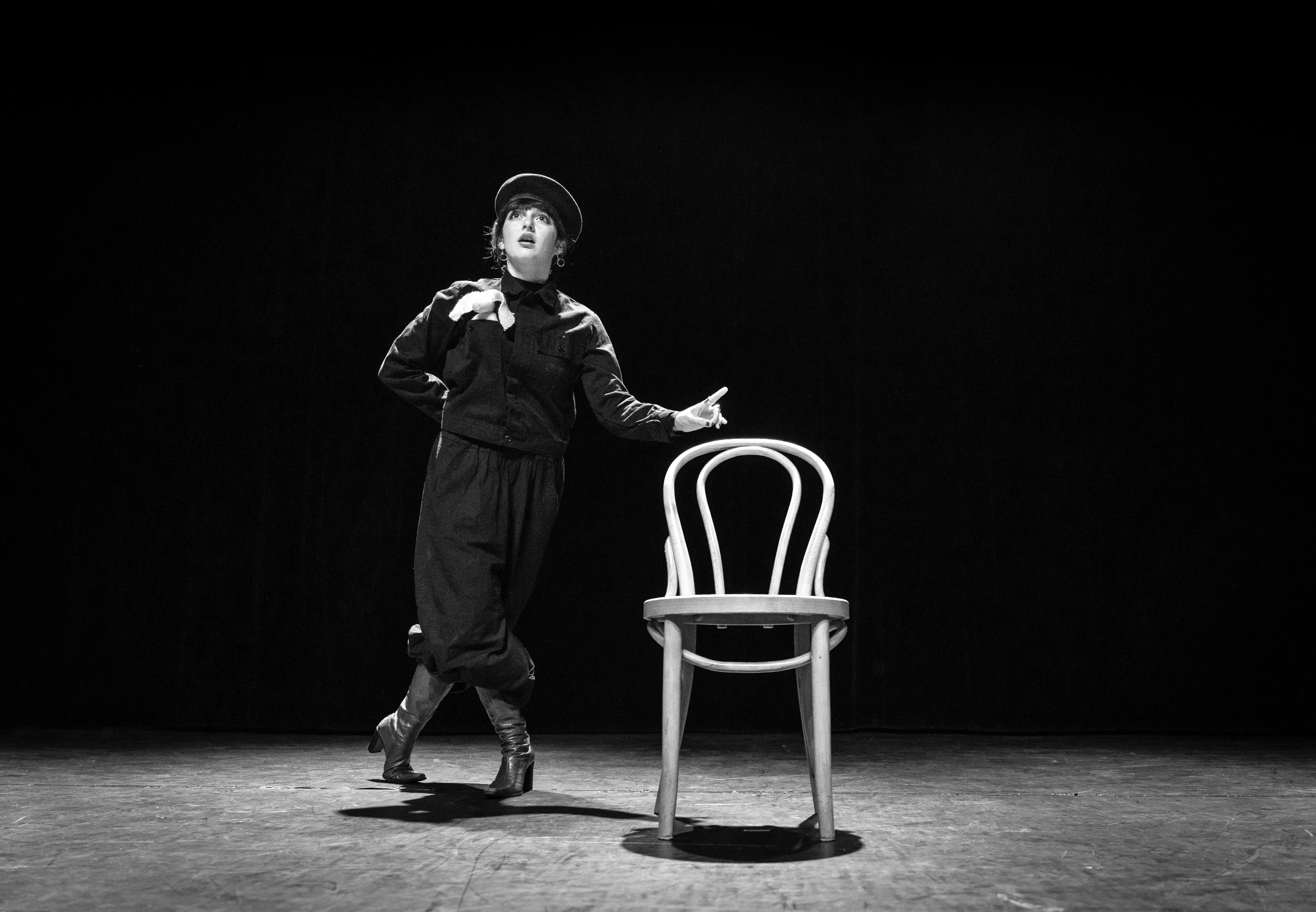
The show at a glance
Macbett is based on Eugène Ionesco’s 1972 play. The work rewrites Shakespeare’s Macbeth in a grotesque key: at its centre are the hunger for power, political violence, the absurdity of war and the way public language can lose meaning.
Tan Tan Teatro’s version is essential and focused on the actors’ play, the rhythm of speech and a sound world made of music, noises, marches, repetitions and sudden shifts in energy.
What to expect
- Running time
- About 1 hour.
- Interval
- No interval.
- Language
- Italian.
- Structure
- A continuous sequence of scenes and transformations, without a pause.
- Music and sound
- The show includes music, noises, fanfares, marches, choral voices and intense sound moments.
- Lighting
- The stage uses contrast, half-light, darkness and changes of atmosphere.
- Audience contact
- No physical contact with the audience is planned.
- Sensitive themes
- Betrayal, murder, power, manipulation.
Plot
Macbett and Banco are two generals serving King Duncan. After an internal war, they crush a rebellion and appear to become indispensable to the kingdom. Power, however, does not bring stability: it opens new desires, suspicions, promises and rivalries.
Around Macbett, a grotesque machine of commands, ceremonies, flattery and deception begins to take shape. The king appears solemn but ridiculous; the winners become new claimants; words of honour become tools of domination. Macbett is pushed towards murder and towards the seizure of the throne.
When Macbett reaches power, the world does not become more orderly. Violence repeats itself, the dead return as intrusive presences, and the ruler increasingly resembles the one he has removed. The story shows a cycle of power that changes faces but not its logic.
Key story moments
First moment
War and reward
The show opens in a world of war, orders and hierarchy. Macbett and Banco fight for Duncan and help restore control over the kingdom. Victory is celebrated, but ambition, calculation and instability are already growing beneath the surface.
Second moment
The promise of power
Macbett receives signs, temptations and words that make him imagine a higher destiny. Power appears as something one can take, not only receive. The performance often works through repetition and distortion: the characters sound solemn, but their words become excessive, ridiculous or threatening.
Third moment
Murder and transformation
Macbett is driven towards the elimination of Duncan. The political act also becomes a theatrical act: the court changes master, but keeps the same violence. Whoever takes the throne must immediately defend it, and every alliance can become a threat.
Fourth moment
The cycle continues
The final part shows a power that cannot create a real order. The ghosts of the past, fear and the absurdity of commands make the new ruler fragile. The fall of one tyrant is not enough: another order may be born through the same mechanisms.
Characters
- Macbett
- A brave and ambitious general. At first he serves the king; then he is drawn by the possibility of taking the throne.
- Banco
- A general and Macbett’s companion. He is an ally, a witness and a possible obstacle in the race for power.
- Duncan
- The king of the country. He is a figure of authority, but also a grotesque character exposed to fear, vanity and political violence.
- Lady Duncan / Lady Macbett
- A central female figure in the transformation of power. She seduces, directs and pushes the action towards crime and conquest.
- Candor and Glamiss
- Rebel lords and then titles of power. Their names mark the passage from war to a new ambition.
- Macol
- A figure linked to succession and to the possibility of a new political order, not necessarily a more just one.
- Officers, soldiers, ladies, bishop, lemonade seller, apparitions and chorus
- Figures that compose the grotesque world of the show: army, court, ritual, trade, prophecy and crowd.
The stage space
The stage space is essential. The set does not realistically reconstruct castles, battlefields or throne rooms: it suggests places of power through bodies, sounds, positions, entrances and exits.
The performers often build collective images: military formations, ceremonies, apparitions, small processions and moments of stillness. The tone can change quickly: a solemn scene may become comic, threatening or absurd.
Sensory information
- The show includes shouting, orders, verbal repetition and moments of strong vocal intensity.
- Sound may include marches, fanfares, blows, sudden noises and live or recorded music.
- The stage may alternate between darkness, half-light and strong visual contrasts.
- Some scenes evoke war, murder, threat, death and apparitions.
- The tone is grotesque: violent events may be treated with black or absurd comedy.
- The language may feel insistent, distorted or deliberately excessive.
Before, during and after the show
Before the performance, you can read the plot, the key story moments and the sensory information. During the performance, you can follow the general movement without catching every single line: many scenes work through rhythm, accumulation, contrast and repetition.
After the show, you can return to this page to reconstruct the sequence of events and identify the main passages: war, temptation, crime, coronation, new fall. For specific requests about surtitles, audio description or accessible materials, you can write to accessibilita@tantanteatro.it.
Available accessibility
Surtitles for this performance are available in Italian, English and French via screen projection, backdrop projection or a dedicated platform. Audio descriptions are available in Italian and are being developed in other languages or on request.